The people featured in this post and who I spoke with all consented to being photographed and to their experiences being shared. This piece reflects what I saw and what was said, not conclusions about lives I do not fully know.
It was a defining moment for a generation of people who lived through it. The Covid pandemic seemed to catch the UK Government completely off guard. In March 2020, as the first national lockdown was introduced, it became clear that there was going to be an enormous economic impact from the restrictions suddenly coming into effect. People simply couldn’t work and many temporary shutdowns became permanent, leaving people without a job to go back to as restrictions lifted.
During the early stages of the national lockdown, the impact on the economy almost immediately raised the question of “how are people going to pay their rent or mortgages?” The Conservative Government, under Prime Minister Boris Johnson, at least saw this issue and introduced protections. In particular these protections supported private rental tenants who suddenly found themselves in rent arrears as a result of the conditions imposed by the lockdown. This support was a huge lifeline for private renters, seeing tenants with private rent debt doubling by May 2021 to some 780,000.
While there were support packages and changes to create protections for renters these were short lived compared to the impact of suddenly finding yourself unemployed and in significant rental debt. Around 130,000 households in England were made homeless during the first year of the pandemic. That number has only increased as the longer term impacts and lack of protections continue to create impossible circumstances for a generation of renters.
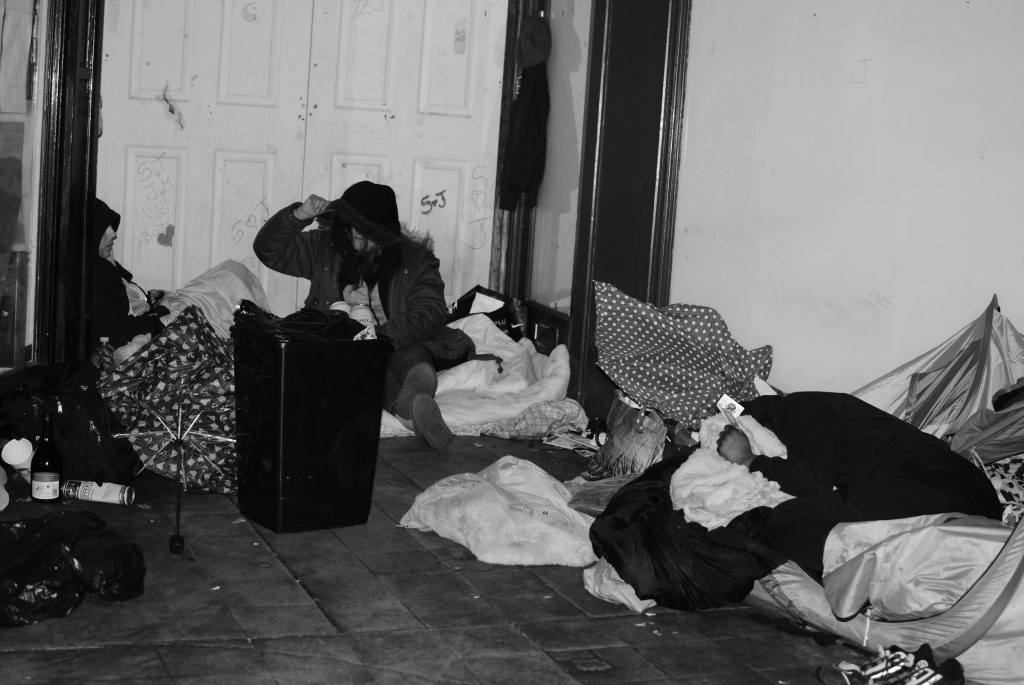
This is what I spent some time chatting about this Friday evening on the streets of Reading, Berkshire. The conversation started with a couple of women and man, in their mid 20’s, who were taking shelter from the rain under a covered doorway where they were currently living. Wrapped in blankets and partially inside a failing tent, one of the women was saying “They just don’t care anymore. They cared during Covid…”
That was what had happened. People had been working and paying their rent until the pandemic hit, when they suddenly found themselves in a situation where there was no work and so things spiralled out of control. The sad truth is that on a cold wet February evening, here in a bundle of damp duvets and buried under blankets was a woman who felt that nobody cared she was sleeping rough. The system which failed to support her has now seemingly forgotten that she is even there.
Despite these three people who are living in absolutely horrendous conditions, this small alcove was only a sample of the scale of homelessness I was about to encounter. To be clear, I wasn’t in Reading to specifically meet and talk with homeless people. I was actually out in town trying to do some work towards my photography learning. Capturing some of the contrast in the wet streets of a town illuminated by night.
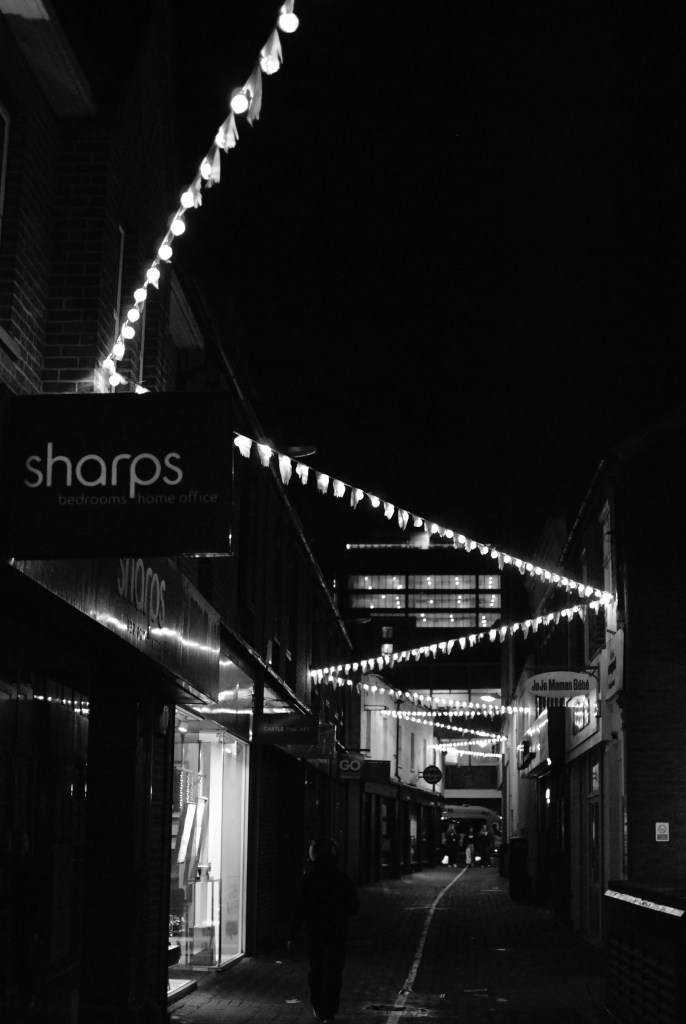
However, in what seems to be quickly becoming almost default wherever I visit of late, you don’t have to look far beyond the strings of fairy lights or the dazzling LED glow of shop windows to let your eyes stumble across signs of the immense struggle facing so many people on the streets of the UK’s towns and cities.
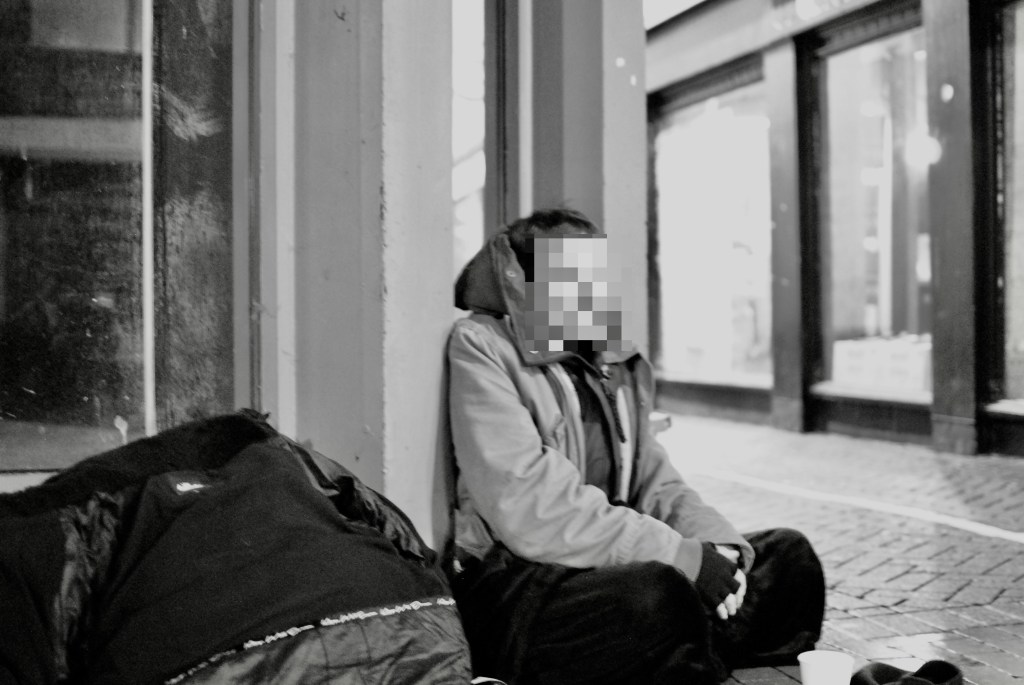
As I turned the corner of one particularly mediocre lit alleyway, I very nearly tripped over a guy who had positioned himself in the relative shelter of a slightly recessed storefront window.
On apologising for nearly walking into him, I got chatting with Tom [not his real name] about how he’d managed to find a dry spot to sit for the evening. Reassuringly he told me he wasn’t feeling as cold this evening and that he had his sleeping bag there if it got bad. It was no place to sleep for the night though, especially with all of the drunken revellers of a busy town passing by. Tom told me that he had somewhere to sleep for the night. He told me had a tent not far from where we were chatting and that there were quite a few people living there together.
He gave me the impression that they had a bit of a community and that they were looking out for each other. Distinctly though, this was yet another person who believed that nobody with any power to help actually cared about him or the people he was living alongside. Instead he and some other people in equally as troubling circumstances had recognised each other’s struggles and were creating somewhere they could at very least stand a better chance of enduring this fight for survival.
Tom told me where I could find this little community of incredibly strong people, which led me to the streets underneath a local theatre and car park complex but, I honestly wasn’t quite ready for what I was about to witness.
As I walked along the one way system, heading down hill to what essentially was an underground entrance to a theatre and a multi-storey car park, I caught a glimpse of of a small tent standing behind some traffic bollards. There, sheltered from a least some of the elements and bathed in the glaring lights of this concrete covered cavern, was a gathering of small tents, odd chairs and old pallets. This wasn’t a scene that I had expected to come across in the UK, let alone in a town centre on a random Friday night. Somehow though, amongst the painfully obvious distress and difficulty of this living situation, there was a feeling of ownership.
A few people had taken this comparatively protected space and were using it to build somewhere they could live alongside one another. Suddenly my eyes were drawn to a scarecrow like figure, stood propped up in the middle of the circle of tents, almost as though it was the center piece of this makeshift town within a town. These people weren’t crashing for the night in an open and unguarded doorway, they were living together in their own reclaimed space. It felt almost rebellious, as if to say “we can still have our own space.”
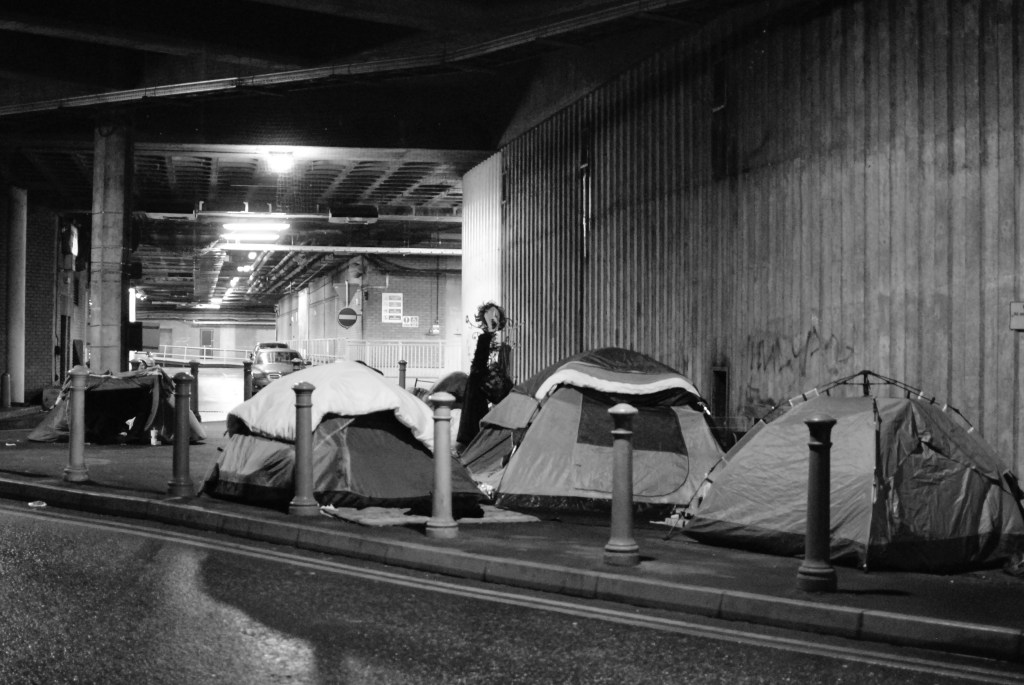
There, tucked away underneath the loud rowdy pubs and late night takeaways, was a true reflection of the scale of the homelessness crisis in this little corner of a Berkshire town. Their tents and furniture mostly protected from the rain, this otherwise forgotten piece of wasted land had become a place that people were building the closest thing to a community that they could. It wasn’t quiet, with the hum of ventilation systems and the drone of passing cars. It was lit up like a battlefield, in a perpetual brightness that you could only sleep through at the height of exhaustion. It was mostly, just about, not quite really dry and it seemed fairly protected from the wind.
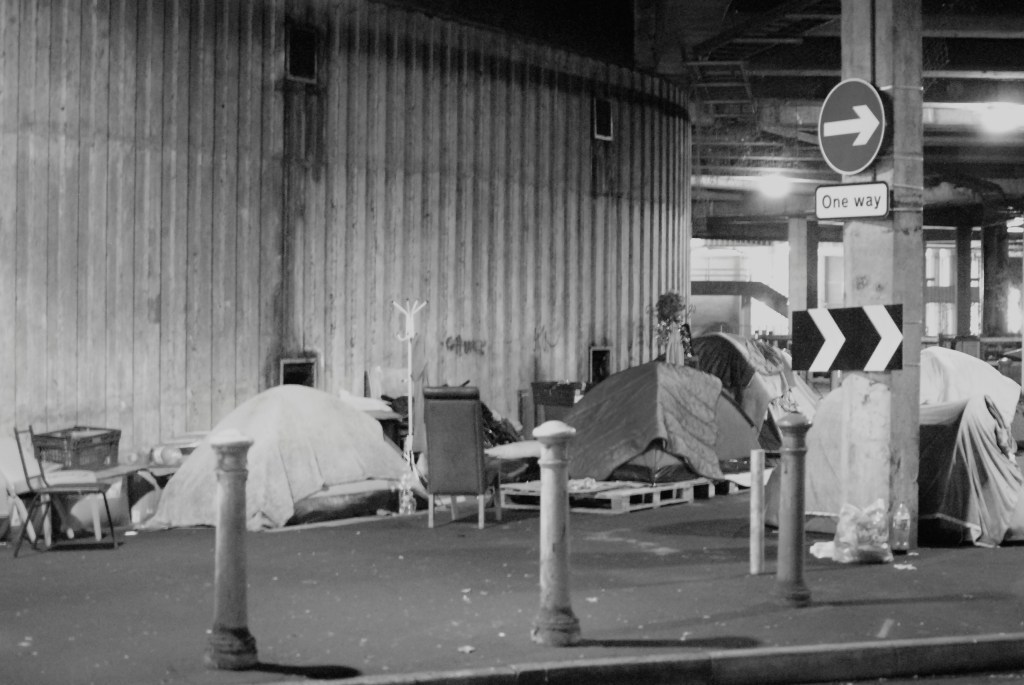
Don’t get me wrong, I am not romanticising this tragic island of people left behind by a system that has failed to protect them. There is nothing but struggle and suffering in the events which have lead to this joint effort to survive in the harshest conditions. There is however a strength that cuts through the decaying urban sprawl. People with simply no place left to turn have turned to each other in the worst of times, in a bid to make their survival just an iota less left to fate. This was a theme throughout the Covid pandemic too.
During the first weeks of lockdown in the UK, something happened that nobody expected. While there was some initial hoarding of things like toilet paper, the usually quite separate lives of people on streets and housing estates up and down the country started to almost connect to each other more. Neighbours starting WhatsApp groups to ask who needed anything from the next run to the shop. People checking in on the older and more vulnerable members of their neighbourhoods. Even the government realised that they needed to pull together to support those facing the challenges of losing work of having their housing put at risk.
The sad truth in the UK in 2026 though is that the sense of caring has been lost to a generation of people facing extreme poverty, a housing crisis and some of the most difficult peacetime conditions the UK has seen. “They cared during Covid…” but that no longer feels like the case.


 What I See
Leave a comment